Year 8 Maths Test PDF with Answers: A Comprehensive Guide
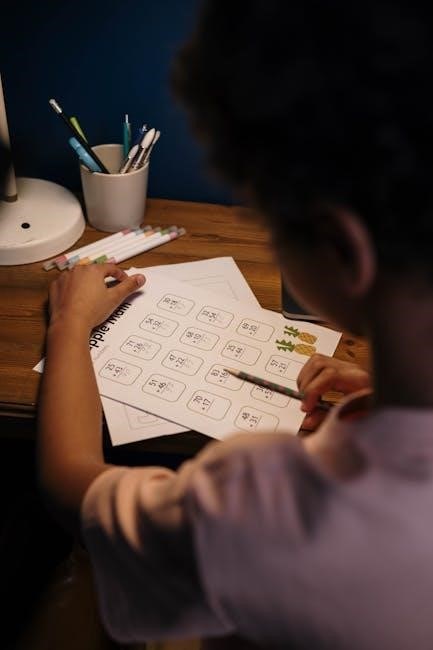
Discover a valuable resource: a Year 8 maths test PDF, complete with answers and a detailed mark scheme. This test, designed for a one-hour lesson,
covers essential Year 8 maths topics, aiding student assessment and revision.
What is a Year 8 Maths Test?
A Year 8 maths test is a formal assessment designed to evaluate a student’s understanding of mathematical concepts typically covered during their eighth year of schooling. These tests, often available as a PDF with answers, assess proficiency across key areas like number, algebra, ratio, and geometry.
The tests aren’t just about recalling facts; they include both procedural questions – testing specific skills – and applied problems, requiring students to use their knowledge in real-world contexts. A typical test, like the one offered by Third Space Learning, is structured for completion within a one-hour lesson, providing a focused evaluation of student progress.
These assessments are crucial for identifying strengths and weaknesses, guiding further learning and preparation for future mathematical studies.
Purpose and Benefits of Practice Tests
The primary purpose of Year 8 maths practice tests, particularly those in PDF format with included answers, is to prepare students for formal assessments and build confidence. Regularly using these tests allows students to become familiar with the question styles and time constraints they’ll encounter in actual exams.
Benefits extend beyond exam preparation. Practice tests pinpoint areas where students struggle, enabling targeted revision. The mark scheme facilitates self-assessment, promoting independent learning and a deeper understanding of concepts.
Furthermore, consistent practice reduces test anxiety and fosters a more positive attitude towards mathematics, ultimately improving overall performance.
Key Topics Covered in Year 8 Maths
A comprehensive Year 8 maths test PDF will assess students across all six core areas of mathematics. These include Number – encompassing integers, decimals, and fractions – and Algebra, introducing algebraic expressions and simple problem-solving.
Ratio and Proportion are crucial, alongside Geometry focusing on angles and shapes. Students will also be tested on concepts like Prime Factors, HCF and LCM, and Indices and Inequalities.
Furthermore, tests often include questions on calculating the Area of a Trapezium. Mastery of these topics is vital for building a strong mathematical foundation for future GCSE studies.
Number – Integers, Decimals, and Fractions
A robust Year 8 maths test PDF thoroughly evaluates students’ understanding of number concepts. This includes proficiency with integers – positive and negative whole numbers – and operations involving them. Tests assess skills in converting between decimals and fractions, and performing calculations with both.
Fractions are examined in various forms, including simplifying, adding, subtracting, multiplying, and dividing. Students must demonstrate fluency in these core arithmetic skills.
Understanding place value and applying these concepts to real-world problems are also key assessment areas within this number strand.
Year 8 marks a crucial step in algebra, and a comprehensive test PDF will reflect this. Students are expected to be more familiar with the concept, moving beyond simple calculations to formal algebraic expressions. The test assesses the ability to simplify expressions by combining like terms.
Solving simple equations – finding the value of an unknown variable – is a core skill tested. Students will also encounter problems requiring them to substitute values into expressions to determine their value.
This section builds a foundation for more complex algebraic concepts later on.
Ratio and Proportion
A solid Year 8 maths test PDF will thoroughly examine students’ understanding of ratio and proportion. This includes simplifying ratios to their lowest terms and understanding equivalent ratios. Students will be expected to apply these concepts to solve real-world problems, such as scaling recipes or dividing amounts proportionally.
Direct proportion – where quantities increase or decrease at the same rate – is a key area of focus. The test will likely present scenarios requiring students to identify and calculate proportional relationships.
Mastering these skills is vital for future mathematical studies.

Geometry – Angles and Shapes
A comprehensive Year 8 maths test PDF will assess students’ geometrical knowledge, focusing on angles and shapes. Expect questions involving identifying different types of angles – acute, obtuse, and right – and calculating missing angles in triangles and quadrilaterals.
Understanding properties of 2D shapes, such as the number of sides and angles, is crucial. The test may include problems requiring students to calculate the area and perimeter of rectangles, squares, and potentially triangles.
Recognizing and classifying shapes accurately is fundamental for success.
Finding a Year 8 Maths Test PDF

Locating a suitable Year 8 maths test PDF with answers is readily achievable online. Third Space Learning provides a free, downloadable test designed for a one-hour lesson, encompassing key Year 8 maths topics and including a complete mark scheme for easy assessment.
This resource is ideal for gauging student understanding and identifying areas needing further support. Several other online platforms also offer similar tests, though verifying the quality and accuracy of both questions and answers is essential before use.
Ensure the test aligns with the curriculum.

Third Space Learning Resources
Third Space Learning offers a comprehensive suite of resources, including a free Year 8 maths test PDF with answers and a detailed mark scheme. This test is specifically designed to be completed within a one-hour lesson, providing a focused assessment of key mathematical concepts.
Beyond the test itself, Third Space Learning provides one-to-one maths tutoring, a cost-effective alternative to traditional methods. They also offer a wealth of free secondary maths resources, accessible through their blog, covering various topics and catering to different learning needs.
Explore their collections for targeted support.
Other Online Sources for Year 8 Maths Tests
While Third Space Learning provides a valuable Year 8 maths test PDF with answers, numerous other online platforms offer supplementary resources for practice and assessment. Searching for “Year 8 maths tests with answers” will yield a variety of options, though quality and alignment with the curriculum can vary.
Consider exploring educational websites and exam board resources for additional practice materials. Remember to always check the accompanying mark schemes to ensure accurate self-assessment and identify areas needing further attention.

Utilize these resources alongside the Third Space Learning test for a well-rounded revision strategy.
Understanding the Test Format
The Year 8 maths test PDF typically comprises 16 questions, designed to be completed within a standard one-hour lesson timeframe. Expect a blend of question types, including both procedural problems – focusing on applying specific skills – and applied problems that require students to utilize their mathematical understanding in real-world contexts.
This test is structured to assess a broad range of Year 8 maths topics, ensuring comprehensive coverage of the curriculum. Familiarizing yourself with this format beforehand will help students manage their time effectively and approach each question with confidence.
Types of Questions – Procedural vs. Applied Problems
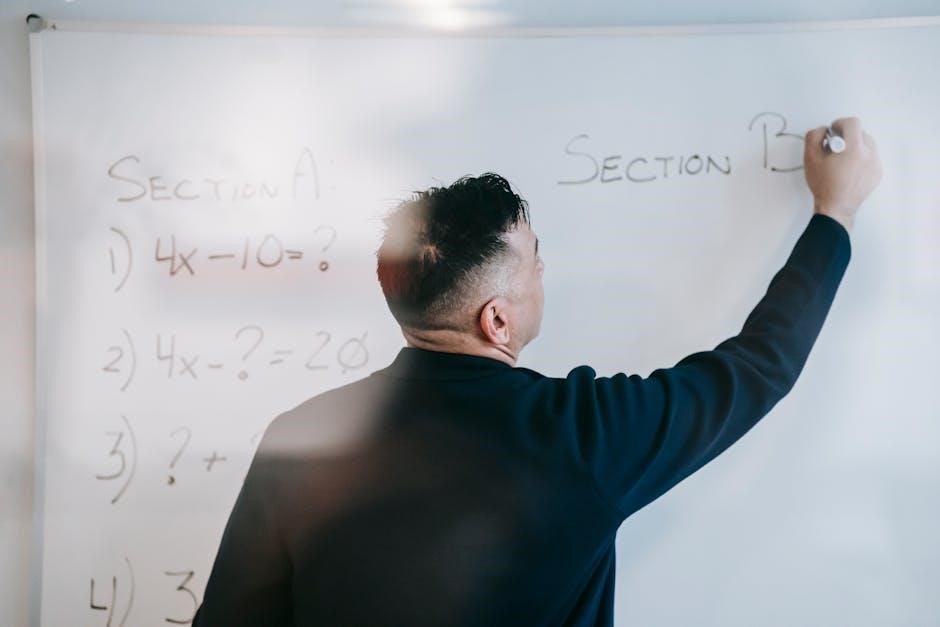
The Year 8 maths test PDF incorporates two primary question types: procedural and applied. Procedural questions assess a student’s ability to execute specific mathematical techniques, like calculating percentages or solving equations, demanding accurate application of learned methods.
Applied problems, conversely, require students to interpret scenarios and determine which mathematical concepts and skills are relevant to find a solution. These questions test problem-solving abilities and the capacity to translate real-world situations into mathematical terms. Both types are crucial for a well-rounded understanding.
Time Allocation – One-Hour Lesson Format
The provided Year 8 maths test PDF is specifically designed to be completed within a standard one-hour lesson timeframe. This structure allows for a focused assessment of students’ mathematical abilities without excessive time pressure, mirroring typical classroom conditions.
The 16 questions are balanced to be achievable within 60 minutes, encouraging students to manage their time effectively and prioritize questions. This format also allows teachers sufficient time to review answers and provide feedback. It’s a practical approach for gauging understanding and identifying areas needing further support.
Using the Answer Key Effectively

The included answer key is a powerful tool for both students and teachers when utilizing the Year 8 maths test PDF. Students can employ it for self-assessment, immediately identifying correct and incorrect answers, fostering independent learning and accountability.
More importantly, the answer key facilitates pinpointing specific weaknesses. By analyzing errors, students can focus revision efforts on challenging topics. Teachers can use the mark scheme to quickly assess overall class performance and tailor future lessons accordingly, ensuring targeted instruction and maximizing student progress.
Self-Assessment and Identifying Weaknesses
Utilizing the answer key allows students to independently evaluate their performance on the Year 8 maths test PDF. This self-assessment process is crucial for developing metacognitive skills and taking ownership of their learning journey.
Carefully reviewing both correct and incorrect answers helps pinpoint areas of strength and weakness. Students should analyze why they made mistakes – was it a conceptual misunderstanding, a calculation error, or simply rushing through the question? Identifying these patterns allows for focused revision, ensuring effort is directed towards the topics needing the most attention, ultimately boosting confidence and understanding.
Mark Scheme Interpretation
The accompanying mark scheme is vital for understanding how each question is assessed in the Year 8 maths test PDF. It details the number of marks allocated to each step of a solution, revealing the specific skills and knowledge being tested.
Beyond simply checking answers, students should analyze how marks are awarded. This clarifies the expected method and level of detail required for full credit. Understanding the mark scheme empowers students to refine their problem-solving approach, ensuring they demonstrate a complete understanding of the mathematical concepts and secure maximum marks in future assessments.
Specific Maths Concepts to Focus On
When preparing with a Year 8 maths test PDF, prioritize key concepts often included in assessments. These encompass prime factors, HCF (Highest Common Factor), and LCM (Lowest Common Multiple) – foundational for number theory.
Additionally, focus on indices (powers and roots) and inequalities (expressing relationships between values). Geometric understanding is crucial, particularly calculating the area of a trapezium. Mastering these areas will significantly improve performance. A solid grasp of these concepts, frequently tested in Year 8, builds a strong base for future mathematical studies and GCSE preparation.
Prime Factors, HCF and LCM
A Year 8 maths test PDF will likely assess understanding of prime factors – numbers divisible only by one and themselves. Decomposing numbers into their prime factors is a fundamental skill.
Relatedly, students need to calculate the HCF (Highest Common Factor) and LCM (Lowest Common Multiple) of given numbers. These concepts are vital for simplifying fractions and solving problems involving ratios and proportions. Proficiency in these areas demonstrates a strong grasp of number theory basics, preparing students for more advanced algebraic manipulations and problem-solving techniques.
Indices and Inequalities
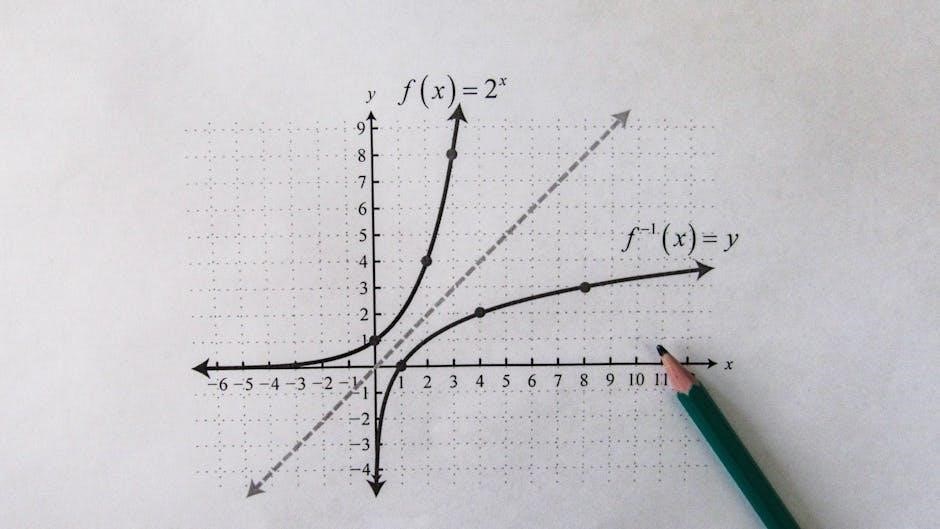
A comprehensive Year 8 maths test PDF will include questions testing understanding of indices (powers and roots). Students should be comfortable with simplifying expressions like 23 or √16, and applying the rules of indices.
Furthermore, the test will assess knowledge of inequalities – mathematical statements showing the relative size of two values. Students need to be able to represent inequalities using symbols (<, >, ≤, ≥) and solve simple inequalities. These concepts build a foundation for more complex algebraic problem-solving and are crucial for understanding mathematical relationships.
Area of a Trapezium
A robust Year 8 maths test PDF will invariably feature questions relating to the area of a trapezium. Students are expected to recall and apply the correct formula: Area = ½(a + b)h, where ‘a’ and ‘b’ represent the lengths of the parallel sides, and ‘h’ is the perpendicular height.
Test questions will likely present trapeziums with varying dimensions, requiring students to substitute values into the formula and calculate the area accurately. This tests not only their formula knowledge but also their ability to identify the relevant measurements within a geometric shape, solidifying their understanding of 2D geometry.
Preparing for the Test – Revision Strategies
Effective preparation for a Year 8 maths test, utilizing a PDF with answers, centers around focused revision. Begin by reviewing key concepts and formulas – number skills, algebra basics, geometry rules, and ratio/proportion principles.
Practicing past papers, including the provided PDF test, is crucial. This builds confidence and familiarizes students with question types. Self-assessment using the answer key identifies weak areas needing further attention. Targeted practice on those specific topics will maximize improvement. Consistent, spaced revision is more effective than last-minute cramming.
Reviewing Key Concepts and Formulas
Before tackling a Year 8 maths test PDF, a thorough review of core concepts is essential. Students should revisit integers, decimals, and fractions, ensuring fluency in operations. Algebraic expressions require understanding of variables and simplification techniques.
Ratio and proportion demand practice with equivalent ratios and problem-solving. Geometry necessitates recalling angle properties and shape formulas. Don’t forget prime factors, HCF, LCM, indices, and inequalities. A formula sheet can be a helpful aid during revision, but memorization is ultimately beneficial for test efficiency.
Practicing Past Papers
Utilizing past papers is a cornerstone of effective Year 8 maths test preparation. Regularly working through these tests simulates exam conditions, building both speed and accuracy. Focus on identifying recurring question types and refining problem-solving strategies.
A test designed for the end of Year 8 provides a realistic assessment, while earlier tests gauge foundational understanding. Pay attention to the mark scheme to understand how points are awarded and where improvements are needed. Consistent practice builds confidence and reduces test anxiety, ultimately leading to better performance.
Test-Taking Tips for Year 8 Students
Success in a Year 8 maths test hinges on careful execution. Always read each question thoroughly before attempting a solution, ensuring a complete understanding of what’s being asked. Show your working clearly – even if the answer is correct, partial credit can be awarded for demonstrated steps.
Manage your time effectively during the one-hour lesson format. Tackle easier questions first to build confidence and secure marks. Don’t be afraid to revisit challenging problems later with a fresh perspective. A calm and focused approach will maximize your potential.
Reading Questions Carefully
A crucial skill for any Year 8 maths test is meticulous reading. Before attempting a solution, fully understand what the question is asking – identify key information and required operations. Misinterpreting a question, even slightly, can lead to incorrect answers despite correct mathematical ability.
Pay attention to keywords like “estimate,” “solve,” or “explain,” as they dictate the expected response. Underline or highlight important details within the problem statement. Taking a moment to carefully dissect each question significantly increases your chances of success and avoids wasted effort.
Showing Your Working
Always demonstrate your steps when solving problems on the Year 8 maths test PDF. Even if you arrive at the correct answer, a lack of working can result in lost marks, particularly for applied problems. Clear, logical steps allow teachers to understand your thought process and award partial credit even if the final answer is incorrect.
Present your work neatly and systematically, using appropriate mathematical notation. This not only aids marking but also helps you identify potential errors during the test. Showing your working is a valuable habit that builds mathematical understanding and improves problem-solving skills.
Adapting Tests for Different Ability Levels
Consider student proficiency when utilizing a Year 8 maths test PDF. A test designed for the end of Year 8 assumes a certain level of prior knowledge. For students starting Year 8, or those needing more support, a different assessment is recommended. This ensures a fairer evaluation of their current understanding.
Utilize tests specifically designed for the beginning of the academic year to establish a baseline. This allows teachers to identify learning gaps and tailor instruction accordingly. Differentiation is key; adjust the complexity of questions or provide scaffolding to meet individual student needs.
Tests for the Start vs. End of Year 8
Distinguishing between assessments is crucial for accurate progress monitoring. A Year 8 maths test PDF intended for the end of the year presumes students have mastered concepts taught throughout. However, using this same test at the year’s commencement provides an inaccurate picture of existing knowledge.
For a fair starting point assessment, seek tests specifically designed for the beginning of Year 8. These focus on reviewing prior learning, particularly from Year 7. This initial test identifies gaps, informing targeted instruction. End-of-year tests then measure growth and mastery of new material.
The Link Between Year 7 and Year 8 Maths
Year 8 mathematics doesn’t begin anew; it’s a natural progression from Year 7’s foundations. Students build upon previously learned concepts, deepening their understanding and expanding their skillset. A solid grasp of Year 7 material is essential for success in Year 8, influencing performance on any Year 8 maths test PDF.
The curriculum encompasses all six mathematical areas, with Year 8 introducing more formal algebraic study and new topics like prime factors, HCF, LCM, indices, inequalities, and trapezium area calculations. Therefore, identifying and addressing any Year 7 gaps is vital before tackling more complex Year 8 concepts.
GCSE Revision and Year 8 Preparation
While GCSEs seem distant, effective preparation begins much earlier, even in Year 8. Utilizing a Year 8 maths test PDF with answers isn’t just about current assessment; it’s a foundational step towards future GCSE success. Understanding core concepts now prevents struggles later.
Paul Coffey, a former GCSE examiner, emphasizes a structured revision approach. This involves refining lessons through extensive experience with GCSE students. Early exposure to problem-solving and test formats builds confidence and resilience. A strong Year 8 base, reinforced by practice tests, significantly eases the transition to GCSE-level mathematics.
Cost-Effective Tutoring Solutions
Supplementing a Year 8 maths test PDF with answers with targeted support doesn’t require expensive, traditional tutoring. Third Space Learning offers an innovative, one-to-one maths tutoring solution as a cost-effective alternative. This approach provides personalized attention, addressing individual student weaknesses identified through test results.
Instead of generalized classroom help, students receive focused guidance from dedicated tutors. This maximizes learning efficiency and builds confidence. Utilizing test PDFs for assessment allows tutors to pinpoint specific areas needing improvement, creating a tailored learning plan. It’s a smart investment in long-term mathematical understanding.
Free Secondary Maths Resources
Alongside utilizing a Year 8 maths test PDF with answers, Third Space Learning provides a wealth of complimentary secondary maths resources. Explore collections filtered by topic to enhance learning and revision. These resources are designed to support students and educators, offering valuable practice materials beyond the test itself.
Access a diverse range of materials – worksheets, practice questions, and guides – all freely available. These resources complement the assessment provided by the test PDF, allowing for targeted practice in areas where students need extra support. Benefit from expert-created content to boost understanding and confidence.

Where to Find Additional Support
Beyond utilizing a Year 8 maths test PDF with answers, consider supplementary support options for enhanced learning. Third Space Learning offers a cost-effective, one-to-one maths tutoring solution as an alternative to traditional tutoring methods. This personalized approach can address individual student needs and accelerate progress.
Paul Coffey, Secondary Curriculum Lead, shares a refined four-stage lesson structure for effective GCSE revision, applicable to Year 8 preparation. Explore their blog for valuable insights and resources. Don’t hesitate to seek expert guidance to maximize understanding and achieve optimal results with the test and beyond.